Newsletter Sponsorship Explained: A Marketer's Guide

New to newsletter sponsorships? Start with our beginner’s guide to newsletter sponsorships for brands before diving deeper into this topic.
Newsletter sponsorship, formally known as sponsored email placement, is one of the most direct and underutilized channels in a modern marketer’s toolkit. While most advertisers chase banner clicks and social impressions, newsletter sponsorship explained properly reveals something different. You get your brand placed inside a trusted, opted-in communication that a real person actively chose to read. This guide covers everything you need: how placements work, how pricing is structured, what compliance requires, and how to run outreach that actually lands deals.
Table of Contents
Newsletter sponsorship explained: what it is and how it works
Newsletter sponsorship pricing: models, rates, and what drives costs
Legal requirements and best practices for sponsored email content
My take: what most marketers get wrong about newsletter sponsorships
Run smarter newsletter sponsorship campaigns with Media Intercept
Key takeaways
Point | Details |
Placement types vary significantly | Primary, secondary, classifieds, and dedicated sends each serve different goals and price points. |
Pricing reflects audience quality | A small, niche newsletter often commands higher CPMs than a large general publication. |
FTC compliance is mandatory | Sponsored content must include clear, conspicuous disclosures near the ad copy. |
Outreach requires specificity | Cold pitches that focus on sponsor benefits and include real data convert far better than generic requests. |
Frequency limits protect ROI | Oversaturating a newsletter with ads reduces engagement and lowers the value of each placement. |
Newsletter sponsorship explained: what it is and how it works
Newsletter sponsorship is a paid arrangement where a brand pays a newsletter publisher to feature promotional content within an email send. This is different from display advertising. There is no programmatic auction, no cookie tracking, and no fighting an algorithm for visibility. Your ad lands in someone’s inbox because they subscribed to that publication and trust it.
Sponsorships typically appear in several formats:
Primary sponsor slot: The most prominent placement, usually at the top of the email or directly after the opening section. This carries the highest price and the most visibility.
Secondary sponsor slot: Placed mid-email, often between editorial sections. Still effective, but at a lower cost than the primary position.
Classifieds or sponsor listings: Short text links or brief blurbs, often grouped together. These are lower cost and suit smaller budgets or testing phases.
Dedicated sends: A standalone email sent to the publisher’s full list on behalf of a single advertiser. Think of it as renting the entire channel for one broadcast.
The booking process follows a clear workflow. Advertisers typically choose a placement type, select available issue dates from a public calendar, and then contact the publisher to confirm and receive an invoice. Once confirmed, you submit your creative assets, including ad copy, imagery if applicable, and your destination URL.
On the publisher side, marketers accept offers, choose send dates, and preview the ad inside the actual email draft before scheduling. This gives both sides a chance to catch errors before the campaign goes live.
Metrics used to evaluate newsletter sponsorships include CPM (cost per thousand impressions), CPC (cost per click), open rates, and click-through rates. CPM is the most common billing model for reserved placements, while CPC is often used when a publisher wants to offer performance-based pricing.
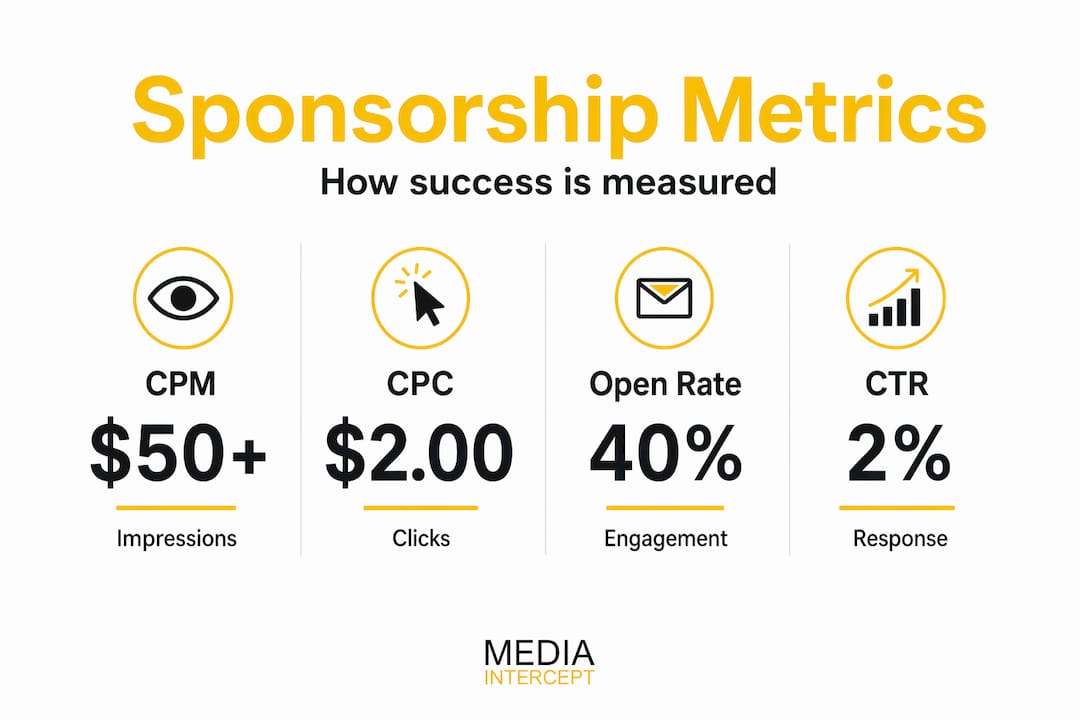
Pro Tip: Ask publishers for their average open rate and click-through rate before booking. A 40% open rate on a 10,000-subscriber list means 4,000 actual eyeballs on your ad. That context changes how you evaluate the CPM.
Newsletter sponsorship pricing: models, rates, and what drives costs
Pricing is where many marketers get confused. Two newsletters with the same subscriber count can have wildly different rates, and both can be fair.
CPM vs. CPC: choosing the right model
CPM pricing charges you per thousand impressions delivered. If a newsletter has 20,000 subscribers and charges a $50 CPM, you pay $1,000 for that placement. CPC pricing charges you only when someone clicks your link. Pricing sponsorships by CPC can be more favorable for high-engagement newsletters, but publishers typically set minimums to protect their revenue floor.

For brand awareness campaigns, CPM is the natural fit. For direct response and lead generation, CPC aligns spend with measurable outcomes. Many marketers use both in combination, running CPM placements for upper-funnel awareness and CPC for conversion-focused sends.
What CPM rates actually look like
B2B and finance newsletters command the highest CPMs, often ranging from $40 to $80 or more for primary slots. General lifestyle and consumer content typically falls in the $20 to $35 CPM range. Niche tech and developer publications can also push above $50, especially when the audience is hard to reach through other channels.
Here is a reference table for typical CPM ranges by niche:
Niche | Primary slot CPM | Secondary slot CPM |
B2B / SaaS | $50 to $80+ | $30 to $50 |
Finance / Fintech | $45 to $75 | $25 to $45 |
Developer / Tech | $40 to $65 | $20 to $40 |
Health / Wellness | $30 to $50 | $20 to $35 |
General Lifestyle | $20 to $35 | $15 to $25 |
What makes rates go up or down
Four factors move the needle most:
Audience engagement. Open rates above 30% signal an active, loyal readership. Publishers with strong engagement can charge more, and the premium is usually worth it.
Niche specificity. A 3,000-subscriber fintech newsletter can charge more per placement than a 30,000-subscriber general news digest. The audience is harder to find elsewhere.
Placement position. Top-of-email spots outperform mid-email by a meaningful margin. Expect to pay 30 to 50 percent more for the primary slot.
Frequency limits. Publishers who restrict sponsorships to one or two per issue protect reader experience. That scarcity raises the value of each slot. If a newsletter runs five ads per issue, you should factor in the attention dilution when evaluating the rate.
Pro Tip: When reviewing a rate card, calculate your effective CPM after adjusting for open rate. A $60 CPM newsletter with a 45% open rate delivers a much lower effective cost-per-view than a $40 CPM newsletter with a 15% open rate.
Legal requirements and best practices for sponsored email content
Compliance is not optional. The FTC has clear expectations for how sponsored content must be labeled inside email communications, and newsletters are not exempt.
FTC endorsement guidelines require disclosures to be clear and conspicuous, placed near the sponsored content, and easy for readers to notice without searching for them. Vague labels like “partner” buried in small text do not meet the standard. The disclosure needs to communicate the commercial relationship plainly.
Common compliance mistakes to avoid:
Placing the disclosure at the bottom of a long email, far from the actual ad
Using insider shorthand like “this issue brought to you by” without specifying it is a paid placement
Skipping disclosure entirely for gifted products or affiliate-style arrangements
Assuming the publisher handles compliance so the advertiser does not have to (both parties share responsibility)
Beyond compliance, practical asset management matters just as much. Publishers limit copy length, control placement location, and require assets to be submitted within specific windows. Missing a creative deadline typically means missing the send date entirely, since newsletter schedules are built around fixed send times.
Before submitting any sponsored placement, treat your ad copy like a legal document: verify the disclosure language, confirm character limits, and submit assets at least 48 hours before the deadline. A missed send date cannot be recovered.
Build a sponsorship brief for every campaign. This document should include your ad copy, destination URL, disclosure language, image files (if allowed), and a contact name for fast revisions. A clear brief reduces back-and-forth and keeps campaigns on schedule.
How to identify, pitch, and secure newsletter sponsorships
Finding the right newsletters to sponsor starts with your audience profile, not your budget. Define exactly who you are trying to reach, their professional role or consumer identity, and what publications they already trust and read.
Once you have a target list, cold email outreach is the most direct path to securing placements. Successful outreach requires targeting the right decision-makers, customizing your message to their audience and goals, and following up on a clear schedule.
Here is a practical outreach sequence:
Research the newsletter thoroughly. Read at least three issues. Note the tone, the types of sponsors already featured, and any sponsorship page they maintain.
Write a subject line that is specific. “Sponsorship inquiry for [Newsletter Name] Q3” outperforms “Partnership Opportunity” every time.
Lead with their audience, not your brand. Open with why your offer is relevant to their specific readers, not a general pitch about your product.
Include social proof and data. Conversion rates, case studies, or current campaign results give undecided publishers a reason to respond.
Follow up twice, at three-day intervals. Two strategic follow-ups significantly improve response rates. After three attempts with no reply, move on without burning the relationship.
Long-term sponsorships are more valuable than one-offs. When a publisher sees consistent results from your campaigns, they are more likely to offer preferred rates, guaranteed slots, and early access to new formats. Treat every publisher relationship as a partnership you want to grow.
Pro Tip: Track all outreach in a simple spreadsheet: newsletter name, contact, date sent, follow-up dates, and outcome. After 20 to 30 outreach attempts, you will start seeing which niches and pitch formats convert best for your brand.
Real-world impact: what newsletter sponsorships deliver
The numbers behind newsletter sponsorship are compelling when you look at outcomes rather than just impressions. Niche newsletters regularly outperform social ads on cost-per-lead metrics because the audience is already self-selected and engaged.
Metric | Newsletter sponsorship | Social media ads |
Average click-through rate | 2% to 5% | 0.5% to 1.5% |
Audience targeting precision | High (niche, opted-in) | Medium (algorithmic) |
Ad fatigue risk | Low (limited ad frequency) | High (repetitive exposure) |
Brand trust signal | High (editorial adjacency) | Medium (feed interruption) |
Lead generation fit | Strong for B2B and SaaS | Varies by platform |
Brand awareness improves measurably when sponsors appear consistently in high-trust publications. Readers associate your brand with the editorial quality of the newsletter, which is a form of credibility you simply cannot buy through programmatic display. Most newsletter creators begin attracting sponsor interest at 500 to 2,000 subscribers in a relevant niche, which underscores how audience quality outweighs audience size.
My take: what most marketers get wrong about newsletter sponsorships
I’ve worked with enough advertisers to know that the biggest mistakes are rarely about budget. They are about mindset.
Most marketers approach newsletter sponsorships the same way they approach banner ads. They treat them as one-time placements to test, measure, and move on from. What I’ve learned is that the real value compounds over time. A reader who sees your brand in two or three consecutive issues starts to associate you with the publication’s credibility. That association does not show up in a single campaign’s click data, but it shows up in branded search and direct traffic weeks later.
I’ve also seen advertisers underestimate compliance. They assume the publisher handles it. The FTC does not make that distinction. When both parties approach disclosure as a shared responsibility, the relationship runs cleaner and neither side faces unnecessary risk.
The other pattern I keep seeing is frequency anxiety. Advertisers want to scale fast and book as many slots as possible. But oversaturation kills engagement. The newsletters worth sponsoring have frequency limits for a reason. Respecting those limits is not a constraint. It is what makes the placement valuable in the first place.
My honest advice: start with two or three high-fit newsletters, run them for at least four consecutive issues, and measure the full-funnel impact before drawing conclusions. Newsletter sponsorship works best when you give it time to build signal.
— Media Intercept
Run smarter newsletter sponsorship campaigns with Media Intercept
If you are ready to move from strategy to execution, Media Intercept is built for exactly that.
Media Intercept connects brands with premium newsletter publishers across high-value niches, handling the discovery, booking, scheduling, and reporting in one place. Whether you are running CPC campaigns for direct response or CPM placements for brand visibility, the newsletter advertising platform gives you the tools to plan, execute, and measure every sponsorship without manual back-and-forth. You can explore available inventory, review publisher metrics, and scale what works. If you want a faster path from budget to results, explore the platform and let our team help you build your next campaign.
FAQ
What is newsletter sponsorship?
Newsletter sponsorship is a paid placement where a brand’s promotional content appears inside a publisher’s email send. Unlike display ads, these placements reach opted-in subscribers in a trusted editorial context.
How is newsletter sponsorship priced?
Pricing typically uses CPM (cost per thousand impressions) or CPC (cost per click) models. B2B and finance newsletters commonly charge $40 to $80+ CPM for primary slots, while lifestyle publications average $20 to $35 CPM.
Do newsletter ads require FTC disclosures?
Yes. FTC guidelines require clear and conspicuous disclosures near sponsored content in newsletters, making the paid relationship obvious to readers. Vague labels or small-print disclosures do not meet the standard.
How do I find newsletters to sponsor?
Start by identifying publications your audience already reads, then review their sponsorship page or rate card. Cold email outreach to the publisher or sponsorship contact is the standard next step. Platforms like Media Intercept also provide curated access to premium newsletter inventory.
How many newsletter sponsorships should I book at once?
Start with two to three well-matched newsletters and run at least four consecutive issues before scaling. Frequency limits set by publishers protect reader engagement, and spreading budget across too many untested placements dilutes your ability to measure what works.
Recommended