How to Boost Brand Awareness With Newsletter Sponsorships

Updated: Jun 5
New to newsletter sponsorships? Start with our beginner’s guide to newsletter sponsorships for brands before diving deeper into this topic.
Most marketers have experienced the same frustration: you run a paid media campaign, the impressions roll in, and then nothing moves. No lift in brand recall, no uptick in consideration, no measurable signal that your audience even noticed you were there. The problem isn’t always the budget. It’s the channel. Display ads get scrolled past, social feeds are oversaturated, and programmatic placements often land next to content your brand would never choose. Newsletter sponsorships offer a fundamentally different path. When you execute them with intention, they connect your brand to audiences who are already leaning in, already trusting the source, and already primed to remember what they read.
Table of Contents
Why newsletter sponsorships are powerful for brand awareness
What you need to prepare: Targeting, metrics, and creative basics
Step-by-step: Launching and optimizing your sponsorship for brand awareness
A smarter play: Why newsletter sponsorship brand awareness is undervalued
Ready to amplify your brand? Next steps with Media Intercept
Key Takeaways
Point | Details |
Target audience fit | Carefully match newsletters with your ideal audience for the strongest brand awareness impact. |
Native ad creative | Ads that blend with the newsletter’s voice and offer one clear CTA are most effective for recall. |
Measure true brand lift | Go beyond clicks by using brand lift studies and exposed vs control comparisons to prove value. |
Benchmark and optimize | Use vertical-specific CPM, open, and CTR benchmarks to set expectations and drive ongoing improvements. |
Why newsletter sponsorships are powerful for brand awareness
Now that we’ve set the stage for the role of brand recall, let’s explore why newsletters stand apart in the digital media mix.
Newsletter sponsorships work because the audience is there by choice. These are people who signed up, confirmed their subscription, and open the email regularly. That permission-based relationship is rare in digital advertising. When your brand appears inside a newsletter, you’re not interrupting anyone. You’re a guest in a space the reader already values.
The benefits of newsletter sponsorship go well beyond simple placement. Here’s what makes the format stand out:
Direct, opted-in audience: Readers actively chose to receive this content, which means your message reaches people with a demonstrated interest in the topic area.
Higher trust and engagement: Email inboxes are personal spaces. Newsletters that readers open consistently carry a level of credibility that banner ads and social posts rarely achieve.
Native message integration: Sponsorship copy that matches the newsletter’s tone feels like part of the content, not an interruption. That integration improves recall and consideration.
Niche targeting: Many newsletters serve very specific professional communities, from fintech operators to DevOps engineers. You can reach a tightly defined segment without wasting impressions on irrelevant audiences.
Compounding impression value: Unlike a display ad that disappears after a scroll, a newsletter sits in an inbox. Readers may return to it, forward it, or reference it later.
As newsletter case studies consistently show, brands that invest in newsletter placements over multiple sends see stronger brand recall and incremental lead volume compared to one-off digital buys.
“Nontraditional channels like newsletters excel in credibility for long-term value, outperforming traditional digital formats in trust-based brand building.”
That credibility is not incidental. It’s structural. When a newsletter author recommends or features your brand, readers associate your message with the trust they already have in that author. That borrowed credibility is one of the most underutilized assets in brand marketing.
What you need to prepare: Targeting, metrics, and creative basics
Having framed the strategic value, we need to lay a strong foundation before launching your sponsorship campaign.
Before you place a single ad, you need to be clear on three things: who you’re trying to reach, how you’ll evaluate the newsletters you’re buying, and what your creative needs to accomplish. Skipping this groundwork is how campaigns end up with impressive open rate stats but zero brand lift.
Define your target persona and desired outcomes. Start with your ideal reader profile. What industry are they in? What role do they hold? What problems are they trying to solve? The more specific you are, the easier it becomes to evaluate newsletter fit. Also define what brand success looks like. Are you building awareness in a new vertical? Reinforcing consideration among existing prospects? Your outcome shapes everything downstream.
Evaluate newsletter audience fit. When choosing newsletters to sponsor, go beyond subscriber count. Ask for verified open rates, click-through rates (CTR), and historical engagement trends. For highest impact, select newsletters with open rates above 30 to 45% and CTR between 2 and 5%, which are strong indicators of an active, engaged list.

Here’s a benchmark table to help you evaluate newsletters by vertical:
Vertical | Typical CPM | Average open rate | Average CTR |
B2B Tech | $10 to $20 | 30 to 40% | 2 to 4% |
Cybersecurity | $25 to $60 | 35 to 50% | 3 to 6% |
Fintech | $20 to $45 | 30 to 45% | 2 to 5% |
Marketing | $15 to $30 | 28 to 42% | 2 to 4% |
Healthcare | $20 to $40 | 32 to 48% | 2 to 5% |
Use the CPC and CPM calculator to model out your expected cost per impression and cost per click before committing to a placement. This helps you compare inventory fairly across different newsletters and pricing models.
Set up your creative for native integration. Your ad copy should feel like it belongs in the newsletter, not like it was dropped in from a banner ad template. That means matching the tone, using plain language, and leading with value rather than promotion. Keep your message focused on one idea and one action.
Essential creative elements for effective newsletter sponsorships:
A clear, single call to action (CTA): Don’t ask readers to do three things. Pick one: visit a landing page, download a resource, or start a trial.
A benefit-led headline: Lead with what the reader gains, not what your product does.
Concise body copy: Two to four sentences is usually enough. Respect the reader’s attention.
A relevant landing page: The page your ad links to should match the promise of the ad exactly. Mismatched landing pages kill conversion rates.
Low-engagement lists inflate CPM risk, so always mitigate this by demanding historical performance data and running A/B creative tests across different placements.
Pro Tip: Always ask the newsletter publisher for list-level performance data over at least the past six months, not just the most recent send. A single high-performing issue can mask a declining list. Trend data tells the real story.
Step-by-step: Launching and optimizing your sponsorship for brand awareness
With your prep complete, let’s walk through the execution: from campaign kickoff to post-send optimization.
Step 1: Select your newsletters and confirm placement details. Based on your persona research and benchmark evaluation, finalize your newsletter shortlist. Confirm placement type (dedicated send vs. inline sponsorship), send date, and creative specifications with each publisher. Get everything in writing.
Step 2: Build and submit your creative. Use your native creative framework. Write copy that matches the newsletter’s tone, include your single CTA, and link to a dedicated landing page you can track separately. Submit creative ahead of the publisher’s deadline, typically five to seven business days before send.
Step 3: Set up tracking before the send. Use UTM parameters (tags added to your URL that identify traffic source, medium, and campaign) on every link. Set up a dedicated landing page or at minimum a unique URL so you can isolate traffic from each newsletter placement. Connect your analytics to capture session data, form fills, and downstream conversions.
Step 4: Monitor the send and capture initial data. Most publishers share open rate and click data within 24 to 48 hours of send. Capture this data immediately and compare it against your benchmarks. Craft native creative matching newsletter tone with a single CTA and track CTR, CPC, and conversions from day one.
Step 5: Optimize based on results. After your first send, identify what worked and what didn’t. Test a different headline, adjust your CTA, or try a different placement position within the newsletter. Iteration is how you improve performance over time.
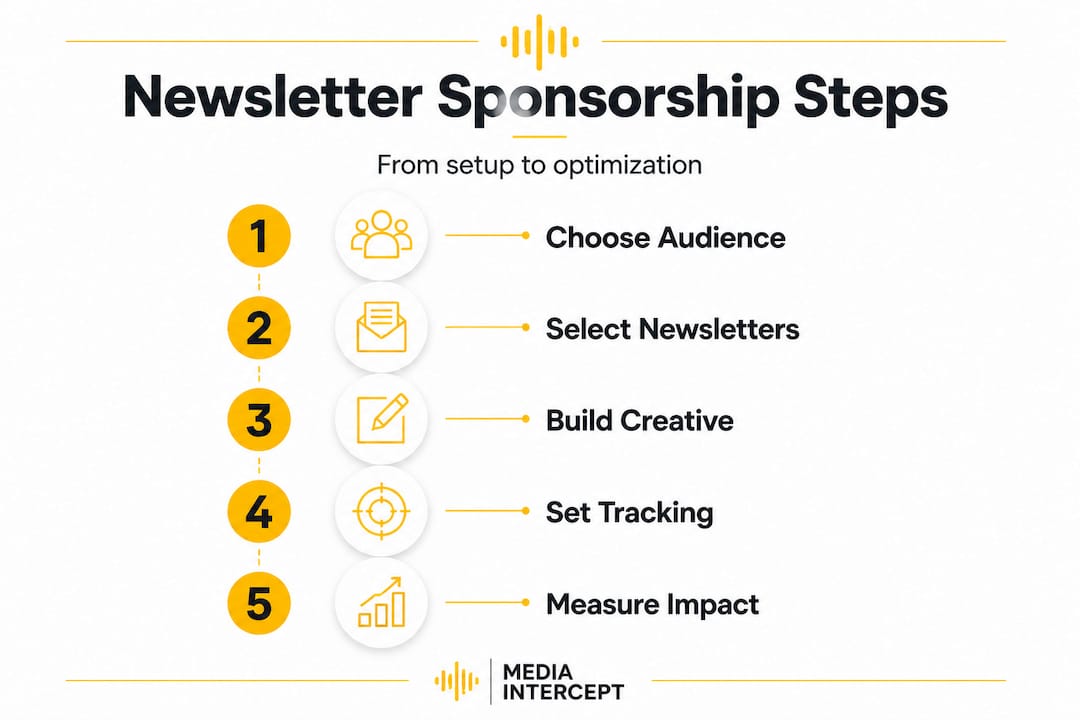
Step 6: Run a brand lift study for awareness campaigns. If your primary goal is brand awareness rather than direct response, clicks alone won’t tell the full story. Use brand lift studies comparing exposed vs. control groups to quantify the actual uplift in brand recall and consideration your sponsorship delivered.
Here’s how traditional performance metrics compare to brand lift measurement:
Metric type | What it measures | Best for |
CTR | Click engagement rate | Direct response campaigns |
CPC | Cost per click | Performance efficiency |
Conversions | Actions taken post-click | Lead gen and sales goals |
Brand recall lift | Change in unaided recall | Awareness campaigns |
Consideration lift | Change in purchase intent | Mid-funnel brand building |
Net Promoter Score shift | Change in brand sentiment | Long-term equity tracking |
A CPC strategy for newsletter ads works well when you need performance accountability. But for pure awareness goals, you need the brand lift layer on top. Both can and should coexist in your reporting framework.
Pro Tip: Run your awareness campaign across at least three consecutive sends in the same newsletter before drawing conclusions. Brand recall builds through repetition. A single send rarely moves the needle on its own.
For more detail on getting the most from your spend, the ROI tips for newsletter sponsorships resource covers advanced optimization tactics worth reviewing before you scale.
How to measure, troubleshoot, and prove brand lift
Launching is just the start. Let’s make sure your sponsorship actually builds brand equity. Here’s how to measure and fix for consistent brand lift.
Once your campaigns are live and running, the measurement phase is where most marketers either prove value or lose budget. The key is knowing which numbers matter for which goals.
What results to expect. For B2B newsletters, open rates often fall between 30 and 45%, with CTR ranging from 2 to 6%. These are strong signals of list health, but they’re not brand awareness metrics on their own. A 3% CTR means 97% of openers didn’t click. Many of those readers still saw your brand, absorbed your message, and may recall it later. That’s awareness at work, even without a click.
The limits of CTR as a brand metric. CTR measures action, not memory. If your goal is brand awareness, you need to measure recall, recognition, and consideration separately. Brand lift studies, even simple survey-based versions, can capture this data by comparing responses from readers who were exposed to your sponsorship against a control group that wasn’t.
Here’s a quick checklist for troubleshooting low engagement:
Low open rate: Test a different subject line or send time. Work with the publisher to understand if list fatigue is a factor.
Low CTR: Revisit your headline and CTA. Is the offer clear? Is the landing page relevant? Is the copy too long?
High CTR but low conversions: The landing page is likely the issue. Align the page message tightly with the ad copy.
No brand lift: You may need more frequency. Three or more sends in the same newsletter typically show stronger recall than a single placement.
“Track CTR, CPC, and conversions, but look beyond clicks with brand lift studies and exposed vs. control group measurement to capture the full awareness impact of your sponsorship.”
Staying current with newsletter sponsorship insights helps you benchmark your results against what’s working across the broader market. Patterns in what’s driving lift across verticals can inform your own strategy faster than testing alone.
A smarter play: Why newsletter sponsorship brand awareness is undervalued
Having mastered the mechanics, let’s reframe how marketers should value and evaluate their sponsorship investments for real long-term brand gains.
Here’s something most brand teams won’t admit: they’re measuring newsletter sponsorships the wrong way, and then blaming the channel when results look flat. The conventional focus on CTR and CPC creates a performance-only lens that misses the majority of the value a newsletter sponsorship actually delivers.
Think about how brand awareness actually works. A reader sees your sponsorship in a newsletter they trust. They don’t click. But three weeks later, when a colleague mentions a problem your product solves, your brand name surfaces in their memory. That recall moment is real value. It influenced a decision. But it never showed up in your click report.
The marketers who get the most from newsletter sponsorships understand that performance marketing and newsletter sponsorship are not mutually exclusive. You can optimize for both. But you have to build a measurement framework that captures both. Clicks are a proxy, not the full picture.
There’s also a compounding effect that most brands walk away from too early. Newsletter audiences are loyal and consistent. When your brand shows up repeatedly in a publication they trust, that repetition builds familiarity. Familiarity builds preference. Preference drives pipeline. This doesn’t happen in one send. It happens across a sustained campaign, and the brands that commit to that timeline see results that short-term buyers never do.
The other missed opportunity is audience transparency. Many marketers accept vague audience descriptions from publishers without pushing for verified demographic and firmographic data. Demanding specifics, including job titles, company sizes, and industry breakdowns, lets you validate fit before you spend. It also gives you the data you need to prove audience quality to internal stakeholders when you’re justifying the investment.
Newsletter sponsorships are one of the few digital channels where you can achieve genuine brand lift, measurable performance, and audience trust simultaneously. Most brands underinvest here because the results don’t fit neatly into a last-click attribution model. That’s not a channel problem. That’s a measurement problem. Fix the measurement, and the value becomes very clear.
Ready to amplify your brand? Next steps with Media Intercept
If you’re looking to operationalize these lessons, Media Intercept offers tailored guidance and turnkey sponsorship campaigns for brands ready to scale their awareness efforts.
We work with marketing teams at brands and agencies to plan, execute, and optimize newsletter sponsorships across premium publisher networks. Whether you’re running your first campaign or scaling an existing program, our platform gives you the tools to move fast and measure what matters.
Explore newsletter advertising for brands to see how our platform connects you with high-quality newsletter inventory, flexible CPC and CPM pricing, and standardized reporting that makes performance easy to track and prove. If you want to go deeper before you launch, our newsletter sponsorship guides cover strategy, benchmarks, and best practices in detail. Our team is ready to help you build a campaign that delivers real brand lift, not just impressions.
Frequently asked questions
What is a typical CPM for newsletter sponsorships?
Typical CPMs range from $10 to $100+, with B2B verticals like tech at $10 to $20, cybersecurity at $25 to $60, and fintech at $20 to $45, depending on audience quality and list engagement.
How do I measure brand lift from newsletter sponsorships?
Conduct brand lift studies comparing exposed and control groups to measure changes in recall and consideration, alongside standard CTR and CPC metrics for a complete picture.
What creative elements drive the best awareness results?
Native creative matching the newsletter’s tone, combined with a single clear call to action and a benefit-led headline, consistently delivers the strongest awareness and engagement results.
What are warning signs of low-value newsletter inventory?
Low open and engagement rates, overly broad subscriber lists, and high CPM with little historical performance data all signal elevated risk, and low-engagement lists specifically inflate your effective cost without delivering proportional brand value.
Recommended
Launch newsletter sponsorship campaigns with flexible pricing and transparent reporting. Get started with Media Intercept.