
How Ad Networks Power Scalable Newsletter Campaigns

Newsletter advertising is still widely managed the way it was a decade ago: spreadsheets, email threads, and manual invoice tracking. That approach works until it doesn’t. Ad networks shift revenue operations from manual deal-by-deal execution to a structured operational system that scales with your ambitions. If you’re a marketing professional at a brand or agency, understanding how newsletter ad networks actually function, how they measure performance, and how they connect publisher inventory to advertiser goals is the difference between campaigns that grow and campaigns that stall.
Table of Contents
Key Takeaways
Point | Details |
Automation drives revenue | Ad networks transform manual ad management into streamlined, scalable operations for publishers. |
Measure what matters | Success depends on aligning campaign goals and tracking newsletter-specific engagement metrics. |
Benchmark for smarter planning | Using CTR and open rate benchmarks enables optimized placement and realistic campaign expectations. |
ROI beats CPM | Campaign ROI hinges on subscriber engagement, not just CPM figures—active readers deliver measurable returns. |
The operational infrastructure of newsletter ad networks
Manual newsletter ad management has real limits. A publisher juggling five sponsors across three newsletters, all tracked in separate spreadsheets, will eventually miss a placement, send the wrong creative, or fail to deliver a performance report on time. Ad networks exist to fix that problem at scale.
When a publisher joins an ad network, the first step is inventory mapping: categorizing available ad slots, issue frequency, estimated open rates, and audience segments into a structured system. This gives advertisers a clear picture of what they’re buying before they commit a dollar. Creative approvals happen through a centralized workflow rather than scattered email chains. Every asset is reviewed for quality and brand safety before it goes live.
The real operational muscle comes from AdOps teams. AdOps coordinates assets, manages placement timing, enforces quality standards, verifies delivery, and ensures performance reporting, treating newsletter advertising as revenue infrastructure rather than a side task. That distinction matters. When AdOps functions properly, advertisers get consistent reporting, publishers get reliable revenue, and both parties can plan ahead with confidence.
Comparison: Manual vs. ad network operations
Function | Manual management | Ad network management |
Inventory visibility | Scattered spreadsheets | Centralized, real-time |
Creative approvals | Email chains | Structured workflow |
Placement tracking | Manual verification | Automated delivery checks |
Performance reporting | Custom, inconsistent | Standardized, comparable |
Billing and payouts | Invoice-by-invoice | Consolidated, predictable |
Disconnected tools create compounding problems. When a publisher uses one tool for email delivery, another for billing, and a third for reporting, data inconsistencies pile up fast. Advertisers lose trust in the numbers. Renewal conversations become harder. The operational gaps that seem manageable at small scale become serious liabilities as campaigns grow.
“Treating newsletter ad management as revenue infrastructure rather than ad hoc execution is what separates publishers who grow their ad revenue from those who plateau.”
Newsletter sponsorships managed through a proper ad network remove these friction points. Publishers can focus on content quality. Advertisers can focus on campaign strategy. The infrastructure handles the rest.
Key benefits of ad network operations for publishers:
Standardized creative submission and approval workflows
Automated delivery verification and post-send confirmation
Consolidated performance reporting across multiple placements
Predictable payout schedules without invoice chasing
Scalable inventory management as subscriber lists grow
Pro Tip: If you manage newsletter ad campaigns across more than two publishers, the time you spend reconciling data manually is time you’re not spending on optimization. Ad networks pay for themselves in operational efficiency alone.
Alignment of success metrics: What advertisers need to know
Infrastructure solves the operational problem. But even the best-run ad network delivers disappointing results when advertisers and publishers aren’t aligned on what success actually looks like. This is one of the most common and most costly mistakes in newsletter advertising.
Different sponsors come to newsletter campaigns with fundamentally different goals. A direct-to-consumer brand may want conversions and trackable revenue. A B2B software company may prioritize lead generation and demo requests. An enterprise brand running a product launch may care only about reach and recall. None of these goals is wrong, but each requires a different measurement framework.
Newsletter ad networks provide scalable targeting and reporting, but require careful alignment of success metrics, whether that means awareness, lead generation, or conversion, and measurement that actually matches newsletter realities. The mistake most advertisers make is applying web display metrics to email environments. Newsletter advertising is an opt-in, high-attention channel. Readers chose to subscribe. That changes what the numbers mean.
What to track based on your goal:
Awareness campaigns: Open rates, impression estimates, and audience size are your primary indicators. Secondary signals include direct traffic spikes or brand search increases during campaign periods.
Lead generation campaigns: Click-through rate (CTR) and landing page conversion rates matter most. Track UTM parameters carefully so you can attribute leads to specific newsletter placements.
Conversion campaigns: Focus on cost-per-acquisition (CPA), revenue generated, and return on ad spend (ROAS). These require tight integration between your newsletter tracking links and your CRM or e-commerce platform.
Mismatched expectations between publisher and brand are a relationship problem before they’re a performance problem. A publisher who promises “massive engagement” without clarifying what that means sets up an advertiser to feel disappointed, even if the campaign technically performed well for the channel. Clear goal alignment before launch prevents those conversations.
“The metric that matters is the one that connects to your actual business outcome, not the one that’s easiest to report.”
Strong audience engagement strategies start with knowing what you’re trying to move. If you’re planning a campaign, take time before launch to document your primary KPI (key performance indicator), your secondary signals, and the minimum performance threshold that makes a renewal worth considering. Share that document with your publisher. It makes every conversation after the campaign run much more productive.
Newsletter ad strategies for brands work best when the measurement framework is agreed upon before the creative is finalized. Once both parties know what they’re optimizing for, creative choices and placement decisions become much more intentional.
Pro Tip: Always set up a dedicated UTM tracking structure for newsletter placements, separate from your social or display campaigns. Newsletter clicks behave differently, and blending them into a single analytics view will distort your data.
Newsletter engagement benchmarks and campaign planning
Benchmarks give you a reality check. Without them, you’re guessing whether your campaign performed well or poorly. With them, you can set realistic expectations, negotiate placements with confidence, and identify genuine outperformers worth scaling.
Here’s where the data gets interesting. B2B outbound email CTR averages around 1.67%, while media and creator-led emails drove a high average CTR of 6.17% in 2025. That’s not a small gap. It reflects the fundamental difference between cold outbound email, where recipients didn’t ask to hear from you, and curated newsletters, where readers show up expecting value. Newsletter advertising inherits the trust the publisher has built.
Engagement benchmarks by email type (2025 data)
Email type | Average open rate | Average CTR |
B2B outbound | 20-25% | ~1.67% |
Niche newsletter | 35-45% | 3-5% |
Media/creator-led | 40-55% | ~6.17% |
Dedicated email blast | 30-40% | 4-6% |
These ranges are starting points, not guarantees. Audience relevance matters more than category. A B2B newsletter that speaks directly to a software engineering audience will outperform a general business newsletter for a developer tools brand, even if the general newsletter has ten times the subscribers.
How to use benchmarks in campaign planning:
Establish your baseline. Before launching, ask the publisher for their last 90-day average open rate and CTR across ad placements specifically. Generic newsletter metrics can include non-sponsored content that performs differently.
Set performance tiers. Define what “good,” “expected,” and “underperformed” look like before launch. If your target CTR is 3% and you land at 2.1%, that’s a data point, not a failure, provided you know your benchmark.
Factor in list quality signals. A newsletter with 50,000 highly engaged subscribers in your target industry will outperform a 200,000-subscriber general list almost every time for niche offers.
Plan for creative iteration. Even strong placements can improve with creative testing. Build your campaign around at least two creative variations so you can identify what resonates.
Explore newsletter CTR benchmarks specific to your vertical before committing to a budget. Category-level benchmarks help you understand what a realistic return looks like before you negotiate.
Understanding measured campaign success is not just about tracking clicks. It’s about building a feedback loop that improves every subsequent campaign. Brand awareness tips specifically for newsletter placements can also shift how you think about metrics beyond direct response.
CPM models, ROI, and mapping subscriber engagement
CPM (cost per thousand impressions) is the most common buying model in newsletter advertising. It’s familiar, predictable, and easy to compare across placements on paper. The problem is that raw CPM comparisons can mislead you into choosing the wrong inventory.

Newsletter CPM rates vary widely, from $15 to well over $100 depending on audience quality, niche specificity, and publisher reputation. A $15 CPM on a 200,000-subscriber general lifestyle newsletter sounds efficient. A $90 CPM on a 20,000-subscriber fintech audience newsletter might deliver better ROI for a financial services brand. CPM is the price of entry. ROI is the actual outcome.
The key is campaign ROI rather than passive CPM comparisons; mapping subscriber quality and engagement to expected clicks and conversions is what produces actionable buying decisions. An engaged list of 15,000 targeted subscribers who open at 50% and click at 5% will generate more qualified traffic than a disengaged list of 100,000 where 10% open and 0.8% click.
How to calculate expected campaign ROI:
Get the publisher’s confirmed open rate and CTR for sponsored placements. Not average newsletter performance. Specifically ad performance.
Estimate your expected clicks. Multiply the list size by the open rate, then by the CTR. That gives you a realistic click volume estimate.
Apply your site conversion rate. If your landing page converts at 4% and you expect 500 clicks, that’s 20 conversions.
Calculate your cost-per-acquisition. Divide total campaign cost by expected conversions to see if the economics work for your offer.
Compare across placements. Use this framework consistently to evaluate multiple newsletter opportunities side by side rather than comparing CPM in isolation.
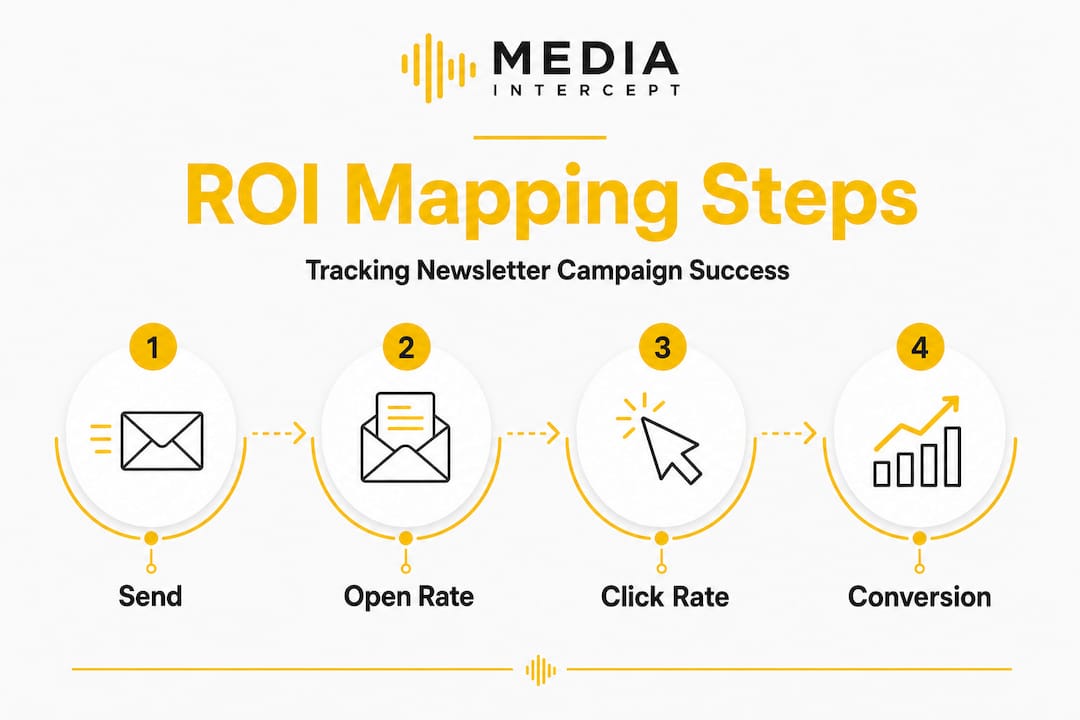
ROI mapping: What to track at each stage
Stage | Metric | What it tells you |
Send | Open rate | Audience interest and engagement quality |
Click | CTR | Creative relevance and offer strength |
Landing page | Conversion rate | Offer-audience fit |
Revenue | CPA / ROAS | True campaign ROI |
Pro Tip: Use the CPM and ROI calculator to model expected returns before committing to a placement. Running the numbers upfront prevents budget surprises and sets a clear performance standard.
Why newsletter ad network management is more than sales
Most guides frame newsletter advertising as a sales process: find a sponsor, negotiate a rate, send the issue, collect the check. That framing explains why so many newsletter ad programs plateau after initial growth.
The more useful frame is operational infrastructure. When your agency or brand treats newsletter ad network management as an AdOps function rather than ad hoc sales execution, disconnected tools and spreadsheets create reporting errors and reduce renewals. The programs that grow sustainably are the ones with systems behind them.
Here’s what we’ve seen time and again: agencies that invest in AdOps infrastructure for their newsletter programs retain advertisers at significantly higher rates. Consistent reporting builds trust. Trust drives renewal conversations. Renewals are where the real revenue accumulates, because the cost of re-selling an existing advertiser is a fraction of the cost of acquiring a new one.
There’s also a measurement maturity argument. When you treat newsletter advertising as a revenue system rather than individual transactions, your data compounds. You start to see patterns across campaigns: which audience segments convert, which creative formats outperform, which send times affect engagement. That intelligence is only available if your infrastructure captures and standardizes data consistently.
CPC advertising strategies illustrate this point well. CPC buying shifts the performance risk toward the publisher, which sounds like a brand advantage. But brands who understand the operational picture know that sustainable CPC partnerships require engaged audiences and clean reporting on both sides. The infrastructure has to work for everyone.
Agencies should prioritize AdOps systems not because it’s operationally tidy, but because it directly drives the business outcomes that matter: lower churn, higher renewal rates, better campaign data, and stronger publisher relationships.
Discover scalable newsletter ad solutions
The insights in this article point toward one practical conclusion: newsletter advertising works best when it runs on a real system, not improvised workflows.
Media Intercept gives publishers and brands exactly that. Whether you’re a publisher looking to grow revenue through newsletter monetization for publishers or a brand ready to run targeted, measurable campaigns through advertising solutions for brands, our platform handles the infrastructure so your team can focus on strategy. Standardized reporting, flexible pricing with both CPC and CPM options, and efficient workflows mean your campaigns launch faster and scale more effectively. Let’s plan your next campaign together.
Frequently asked questions
What does an ad network do for newsletter publishers?
Ad networks automate ad placements, enforce quality standards, and provide standardized performance reporting, replacing the manual processes that slow publishers down and introduce errors.
How should brands measure the success of newsletter ads?
Brands should align their goals before launch and track opens, clicks, and conversions with clear KPIs. Success metrics must match newsletter realities rather than web display benchmarks.
What are average newsletter CTR benchmarks?
B2B newsletter CTR averages around 1.67%, while media and creator-led newsletters averaged 6.17% CTR in 2025, reflecting the higher engagement levels of opted-in audiences.
Why is CPM less relevant for newsletter ad ROI?
CPM reflects cost, not return. Newsletter ROI depends on subscriber engagement quality, open rates, CTR, and downstream conversions, making passive CPM comparisons an incomplete buying signal.
Recommended
